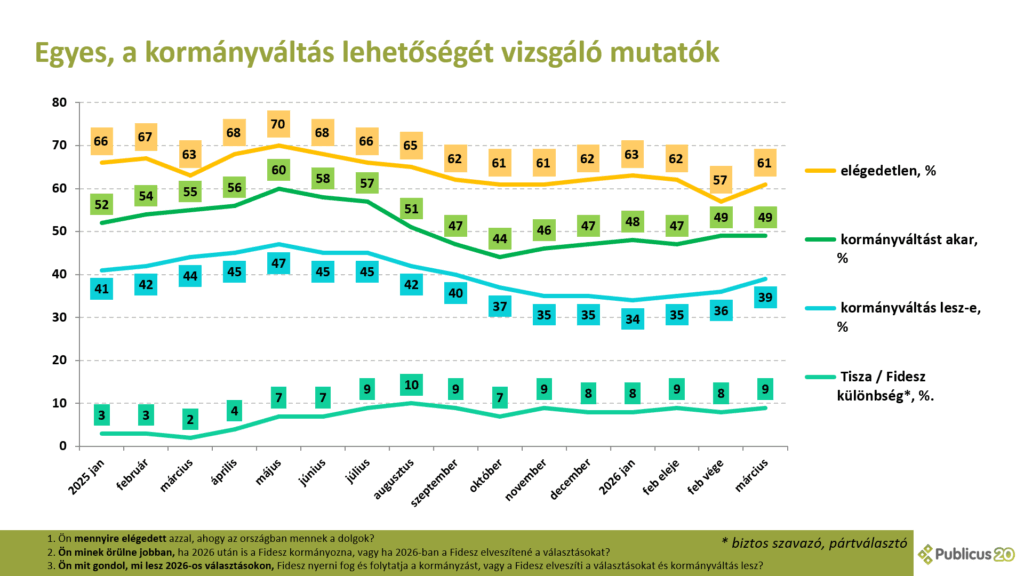


On the surface, our data from late March 2026 apparent shows no visible change. Party support has shifted only minimally—it is as if voters from the DK and the Two-Tailed Dog Party (MKKP) continue to migrate toward the Tisza Party, while Fidesz “vacuums up” those among the undecided who show any openness to them. However, the numbers next to party names always show the past! People are interested in the future. To satisfy that hunger, we must look deeper. Let’s analyze the questions that serve as the Holy Grails of election forecasting.
You may read this piece on my Substack page, by clicking here. Once you are there, please don’t forget it subscribe!
Has the “Bandwagon Effect” begun?
As pollster, I always say: math is the foundation of everything, but politics is largely about psychology. We have a “trillion-dollar question” that decides the outcome of every election: who is going to win? It is not just about who people want to vote for, but what they feel in the air. Curiously, our latest data from the end of March suggests a turnaround is underway—one that carries the potential for a total breakthrough.
Why isn’t party preference enough?
Before we dive into the numbers, let’s be clear: the “who would you vote for?” question only measures momentary intent. Yet, election results are often decided by the last-minute shifts of the undecided—especially in a situation as sharp as this, burdened by 16 years of the NER (System of National Cooperation), where after so many disappointments, a sense of learned helplessness weighs heavily on the shoulders of opposition voters.
This is why we must use indirect indicators: belief, betting, and the opinions of neighbors. These do not measure desires; they measure social gravity. This is the atmosphere that eventually “pulls in” the undecided or the persuadable toward the expected winner. In professional terms, we call this the bandwagon effect.
1. The Psychological Shift: 39–38
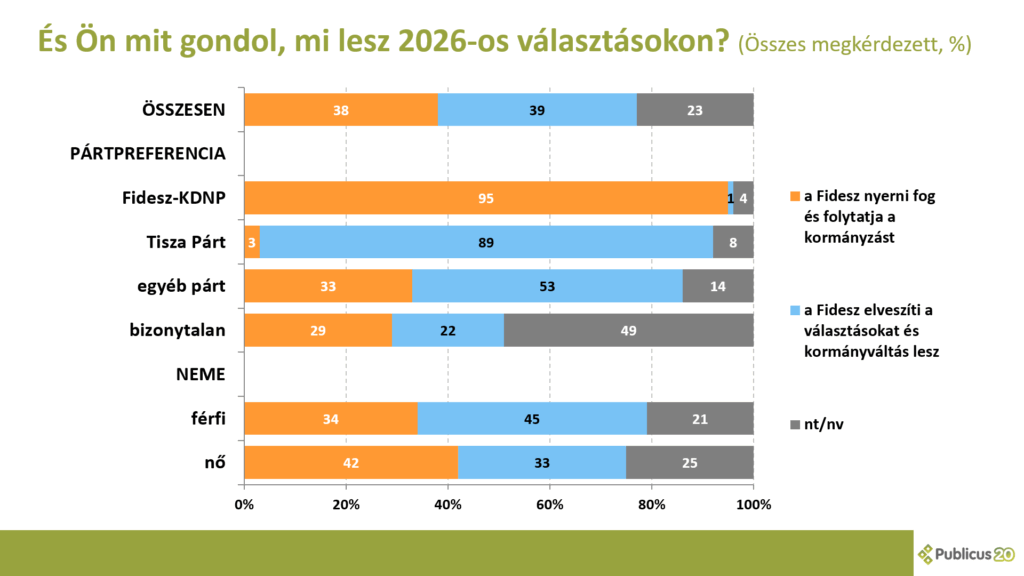
Until now, in our polls —even as support for Tisza grew steadily—the majority of voters still believed Fidesz would somehow “fix it”. At the end of February, the ratio was still 40–36 in favor of those believing the ruling party would continue. By now, however, this has flipped: 39% believe there will be a change of government, and 38% believe Fidesz stays.
This single percentage point difference is actually a sign of a massive mental dam breaking. Belief in a victory is a key indicator. Since we began measuring this indicator in January 2025, this is the first time a relative majority believes in the possibility of a change of government. Furthermore, this happened as Fidesz voters became increasingly uncertain, while the confidence of Tisza voters built slowly but steadily. This is critical because an undecided but dissatisfied voter does not like to vote for a loser; they only move when they see the reality of change.
2. The “10,000 HUF Test”: Tisza vs. Fidesz
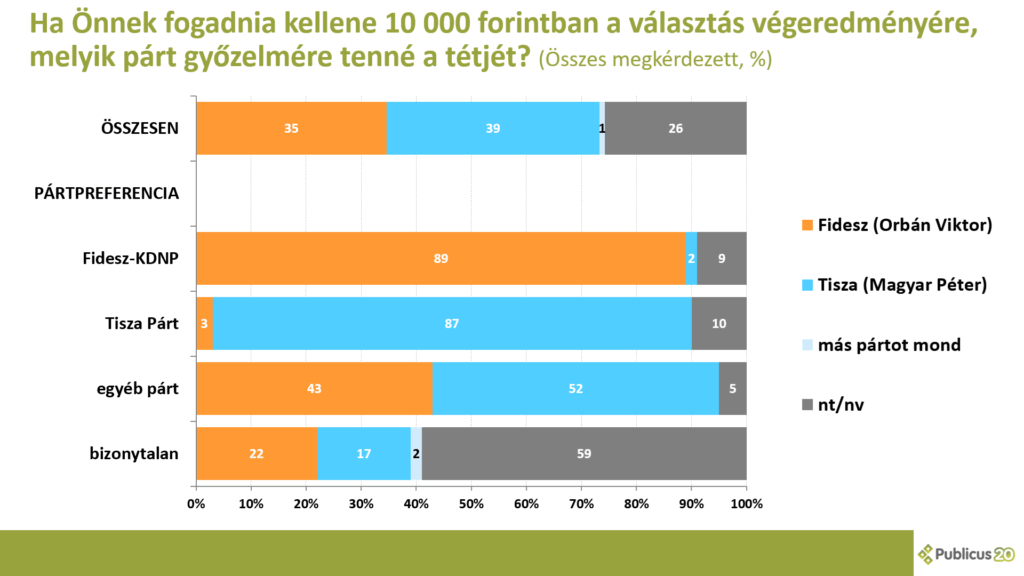
We have another metric that is perhaps even more honest than simple party preference: the forced choice. We presented a scenario: “If you had to bet 10,000 forints on the election outcome, who would you bet on?”
- 39% would bet on a Tisza victory.
- 35% would put their money on Fidesz.
When people risk their own money, wishful thinking takes a backseat. This question filters out the political “noise” and builds on the voters’ hard-earned sense of reality. Tisza’s 4-point lead here indicates that the shift is gaining ground in the deeper layers of society.
3. What does the neighbor see? (39 vs. 28)
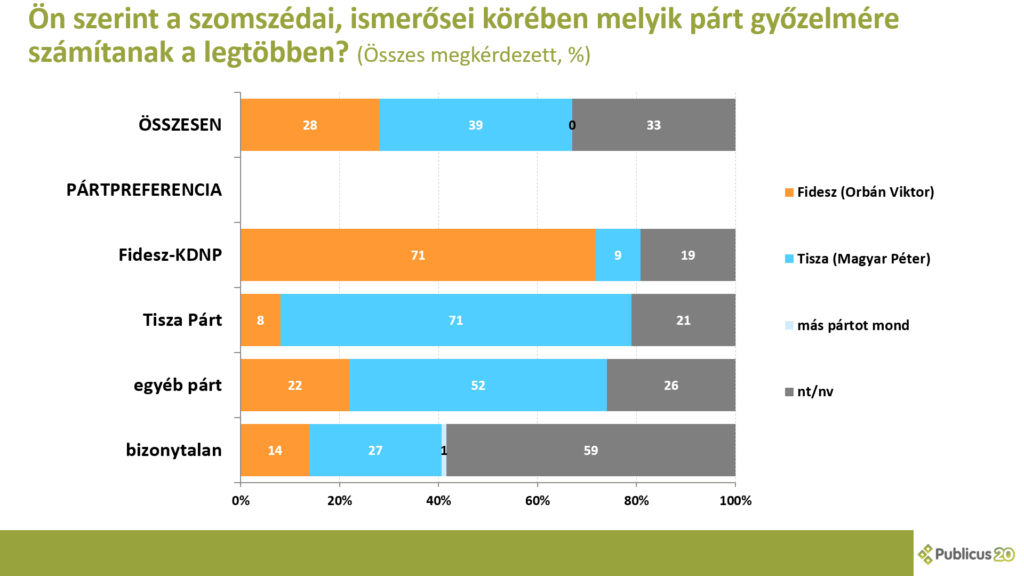
Finally, let’s look at social perception, or social projection. We asked: “In your circle of neighbors and acquaintances, who do most people expect to win?”
- 39% say Tisza is the frontrunner in their circle.
- Only 28% feel their environment expects a Fidesz victory.
This 11-percentage-point gap is of immense significance because people often sense a change in their environment sooner than they would admit it about themselves—especially after four consecutive Fidesz victories. Often, this indicator is the most accurate predictor of the election atmosphere.
The final week’s match and the dam breach
The math shows that among certain voters, Tisza stands at 49%, while Fidesz is at 40%. But the real question is what happens to that critical 7–8% of voters who decide in the final days, or even in the voting booth. If the perception of who will win is established, a tectonic shift can be expected in the final week. This is exactly what happened in the last three elections:
- 2019 EP Election: In the final week, MSZP and Jobbik voters flowed at high speed toward DK and Momentum.
- 2022 General Election: In the final days, hundreds of thousands of voters moved toward Fidesz.
- 2024 EP Election: In the 1–2 weeks before the vote, DK-MSZP-Párbeszéd voters found their way to the Tisza Party.
If this psychological row of dominoes holds until the final days, it moves beyond mere statistics. This is political gravity, which can decide everything at the end. In this scenario, the expected record turnout of 70–75% no longer favors Fidesz, but those wanting change. Fidesz’s reserves lie among the passive but “spiritually Fidesz” undecideds, but the bandwagon effect currently works against them. If a voter feels their own camp has defected or become uncertain (as the 39–28 “neighbor indicator” suggests), they are more likely to stay home at the last minute—which could be fatal for the ruling party.
A 9-point lead makes a Tisza victory on the national list easy to see, but the election and the majority are decided in the 26 battleground districts. And that is a much tougher nut for Tisza to crack. Their candidates entered the stage late, face name-recognition issues, and most perform below the party’s list results. However, when these three indirect indicators—belief (39-38), betting (39-35), and neighbor perception (39-28)—flip simultaneously, it can create a perfect storm. This storm could push a dozen “swing” districts through the eye of a needle, bringing about the long-awaited change of government by many.