

Commissioned by Népszava, Publicus Institute conducted a nationally representative public opinion poll between May 5–14, 2026, surveying 1,001 respondents via telephone. The poll examined party support and voters’ opinions on the new Tisza government.
Publicus‘s research proved to be the most accurate in the 2026 parliamentary elections!
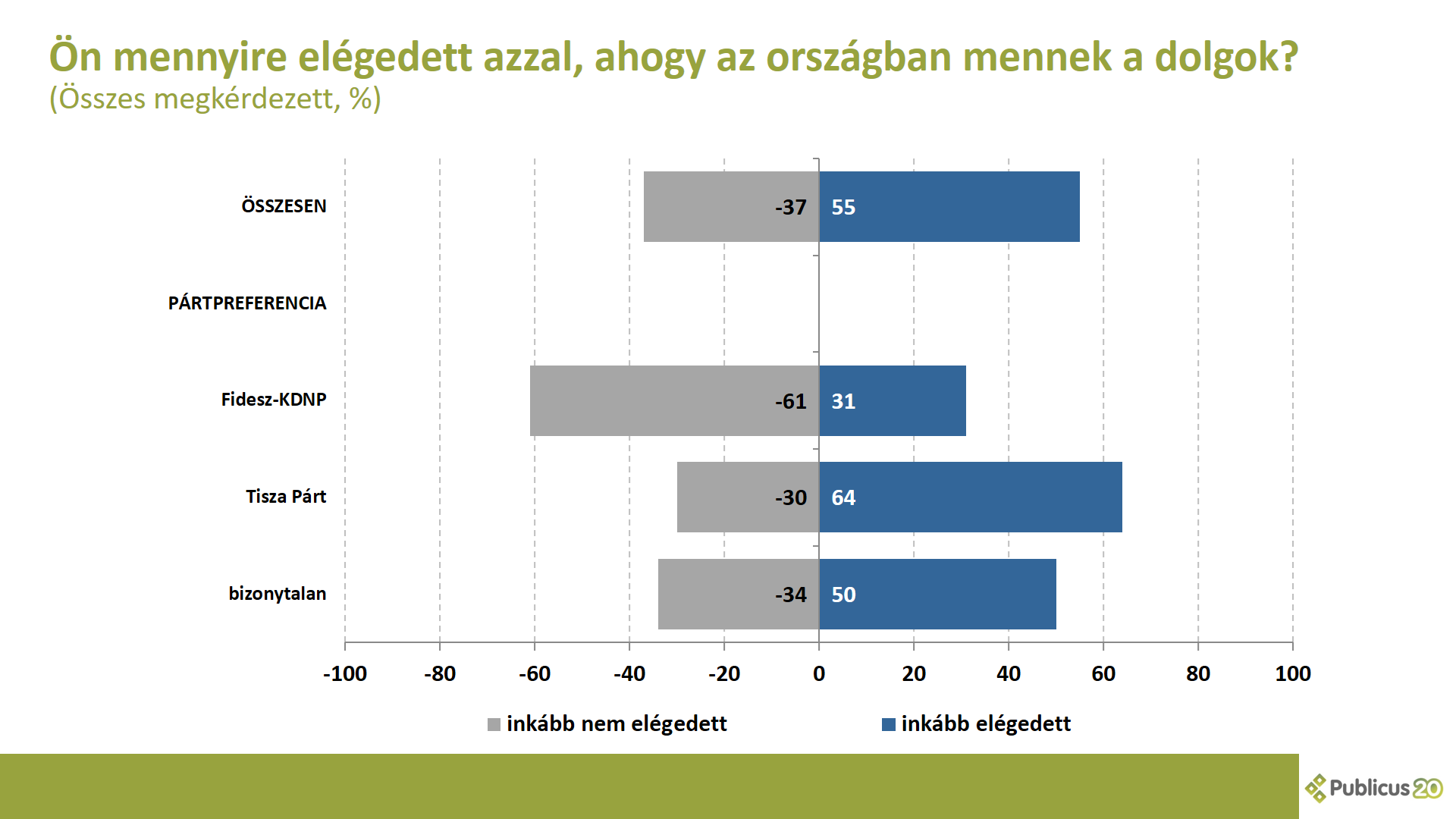
The majority of respondents (55 percent) are rather satisfied with how things are going in the country. This view is shared by:
- 64 percent of Tisza Party voters,
- 50 percent of undecided voters,
- 31 percent of Fidesz voters.
(During our final survey conducted before the elections, only 36 percent of respondents were rather satisfied with the country’s direction.)
The massive voting enthusiasm witnessed during the elections is still observable: 89 percent of respondents stated they would definitely go to vote if parliamentary elections were held this coming Sunday.
Party Support
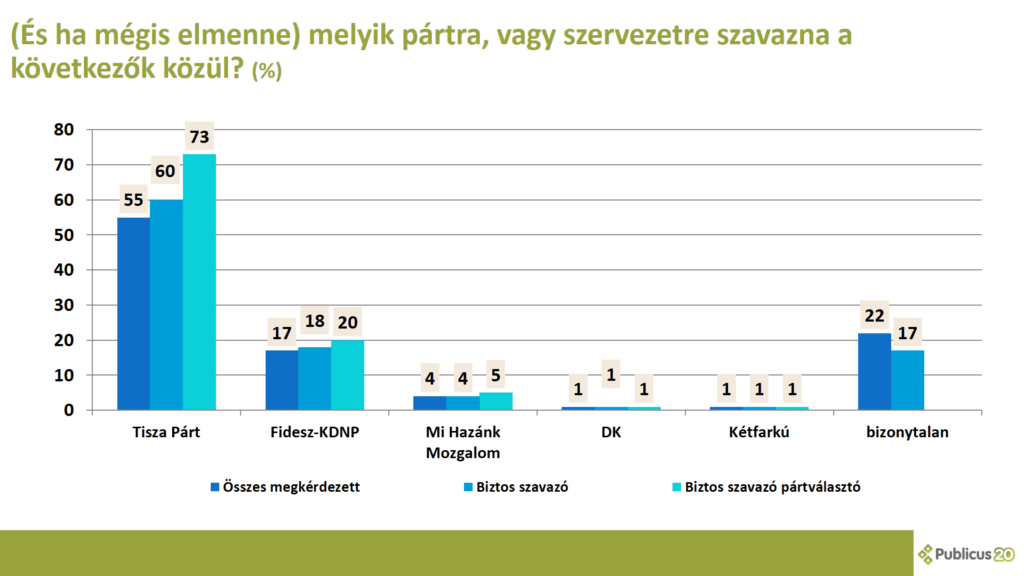
The Tisza Party holds a massive lead in party support, with Fidesz trailing far behind.
- Among certain voters with a clear party choice: The Tisza Party stands at 73 percent support, while Fidesz has 20 percent. Since the elections, the former ruling party has lost 19 percentage points of its support, while the Tisza Party’s support has increased by 21 percentage points.
- Among all respondents: The Tisza Party achieved 55 percent support, while Fidesz stands at 17 percent. Among the smaller parties, Mi Hazánk holds 5 percent, while DK and the Two-Tailed Dog Party (MKKP) stand at 1 percent each.
- The proportion of those undecided about their party choice is 22 percent among all respondents.
Prime Ministerial Suitability
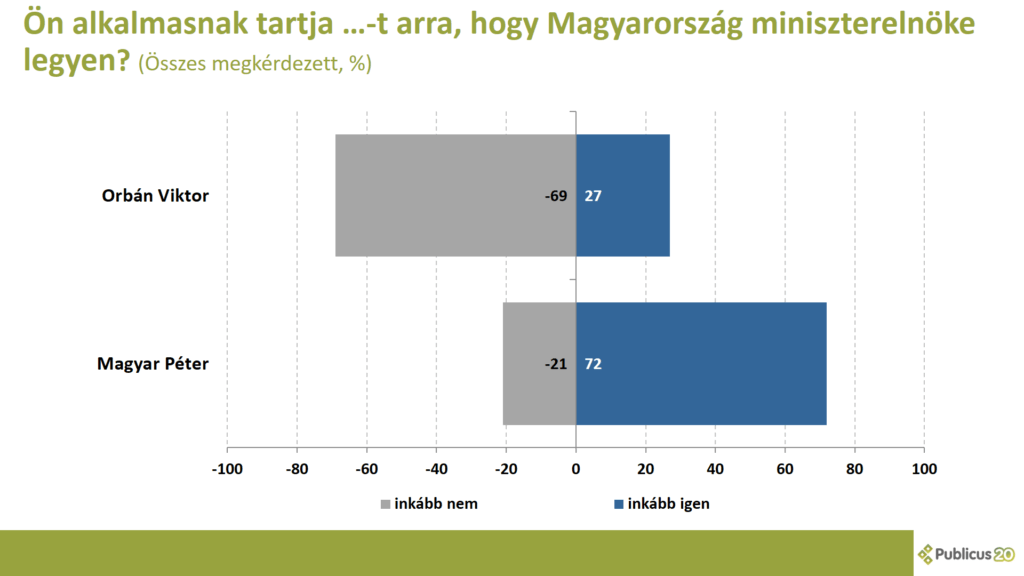
- Péter Magyar: 72 percent of respondents consider him rather suitable, while 21 percent consider him rather unsuitable to be the Prime Minister of Hungary.
- Viktor Orbán: 27 percent of respondents consider him rather suitable, while 69 percent consider him rather unsuitable to be the Prime Minister of Hungary.
Expectations and Assessment of the New Government
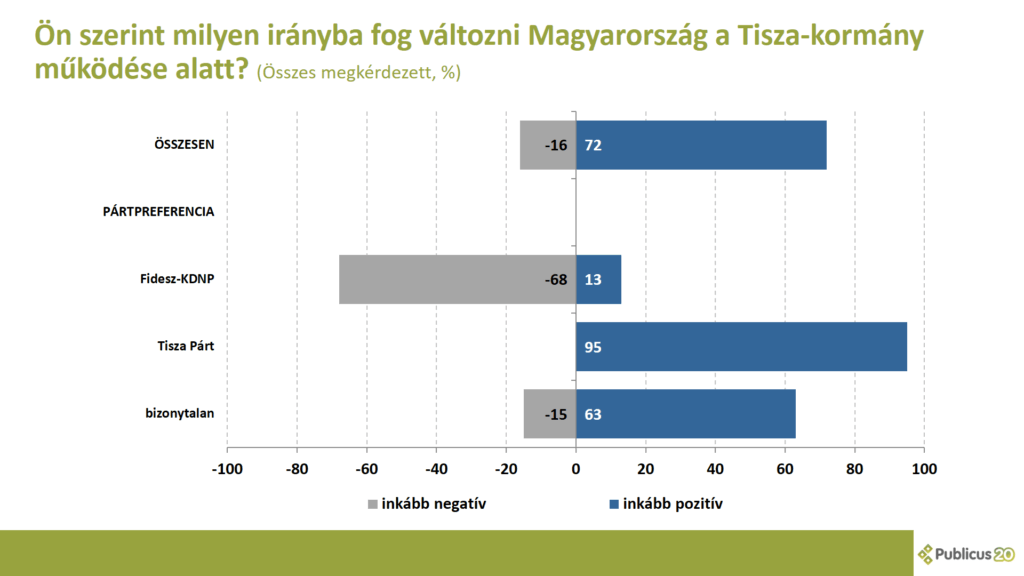
Expectations regarding the activities of the new ruling party are high. Nearly three-quarters of respondents (72 percent) believe Hungary will change in a rather positive direction under the Tisza government. This is expected by 95 percent of Tisza Party voters, 63 percent of undecided voters, and 13 percent of Fidesz voters.
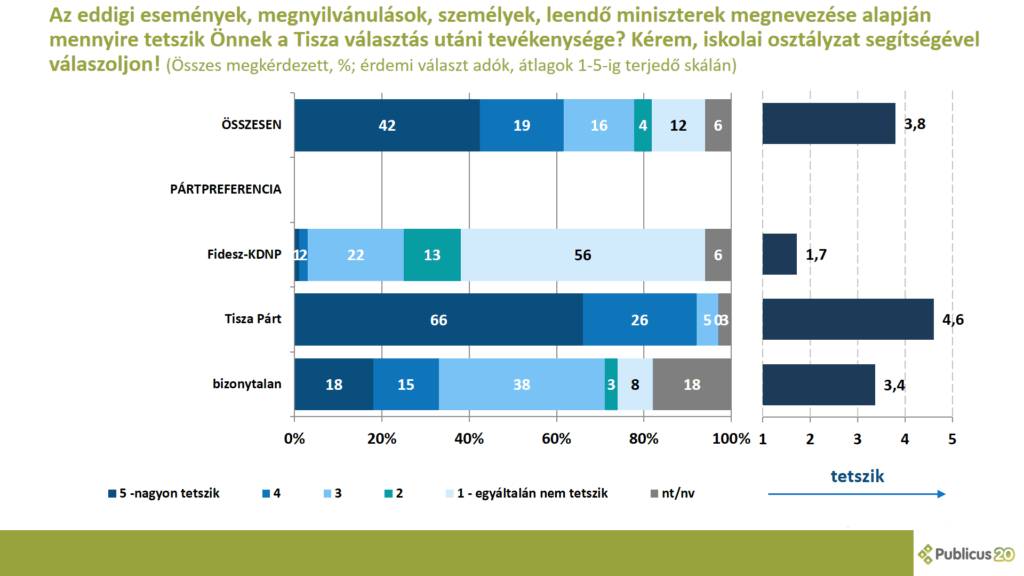
On a scale from 1 to 5, respondents rated Tisza’s post-election activities—based on events, statements, figures, and the naming of future ministers so far—at 3.8 points.
- Tisza Party voters gave 4.6 points,
- Undecided voters 3.4 points,
- Fidesz voters 1.7 points.
If we round these into Hungarian school grades (where 5 is Excellent and 1 is Fail):
- Tisza voters give a 5 (Excellent),
- Fidesz voters give a 2-minus (Poor/Near Fail),
- Undecideds give a 3-plus (Fair).
- Overall, this amounts to a 4-minus (Good) among all respondents for the new government’s first month.
About Publicus Institute
Publicus Institute has been a defining market and opinion research company in Hungary for 20 years. It measured the most accurate results for, among others, the 2026 parliamentary elections, the 2024 mayoral and European Parliament elections, the 2019 mayoral election, and the 2016 “quota referendum.” You can learn more about our further results by clicking here.
Methodology
The survey was conducted between May 5–14, 2026, by Publicus Institute, interviewing 1,001 respondents via telephone, representing the adult population of Hungary, as part of the Publicus Omnibus. Distortions resulting from sampling were corrected using weights based on the 2022 HSO (KSH) Census data. The composition of the sample by gender, age, education, region, and settlement type reliably represents the composition of the domestic population by similar characteristics.
Given the sample size, it can be stated with 95 percent confidence that the data obtained from the study deviate by a maximum of +/- 3.1 percentage points from what would have been obtained by interviewing all Hungarian residents aged 18 or older. However, this sampling error is larger when a distribution is provided not for the total pool of respondents but for a smaller subgroup.