

It appears that the numbers and the underlying psychology have finally aligned. Based on our latest poll – carried out between April 7 and 9 -, what voters previously only hoped for or sensed is now becoming a hard political reality. This is our final poll before Sunday’s showdown, and every indicator is pointing in one direction: the breeze that was only a faint gust two weeks ago has formed into a perfect storm, and it has arrived.
You may read this piece on my Substack page, by clicking here. Once you are there, please don’t forget it subscribe!
The Perfect Storm is Around the Corner
Two weeks ago, we spoke only of the signs of a dam breaking, but according to our latest—and final—pre-election research, the water is now sweeping everything away. The math is ruthless: the gap between the Tisza Party and Fidesz did not close in the campaign home stretch; instead, it opened wider than ever before. This was significantly aided by the fact that the issues defining the campaign finish were all unfavorable for Fidesz and favorable for Tisza. But deep down, the processes within the voters’ psyche also favored Tisza. Let’s look at them.
The Failure of the “Money Rain”
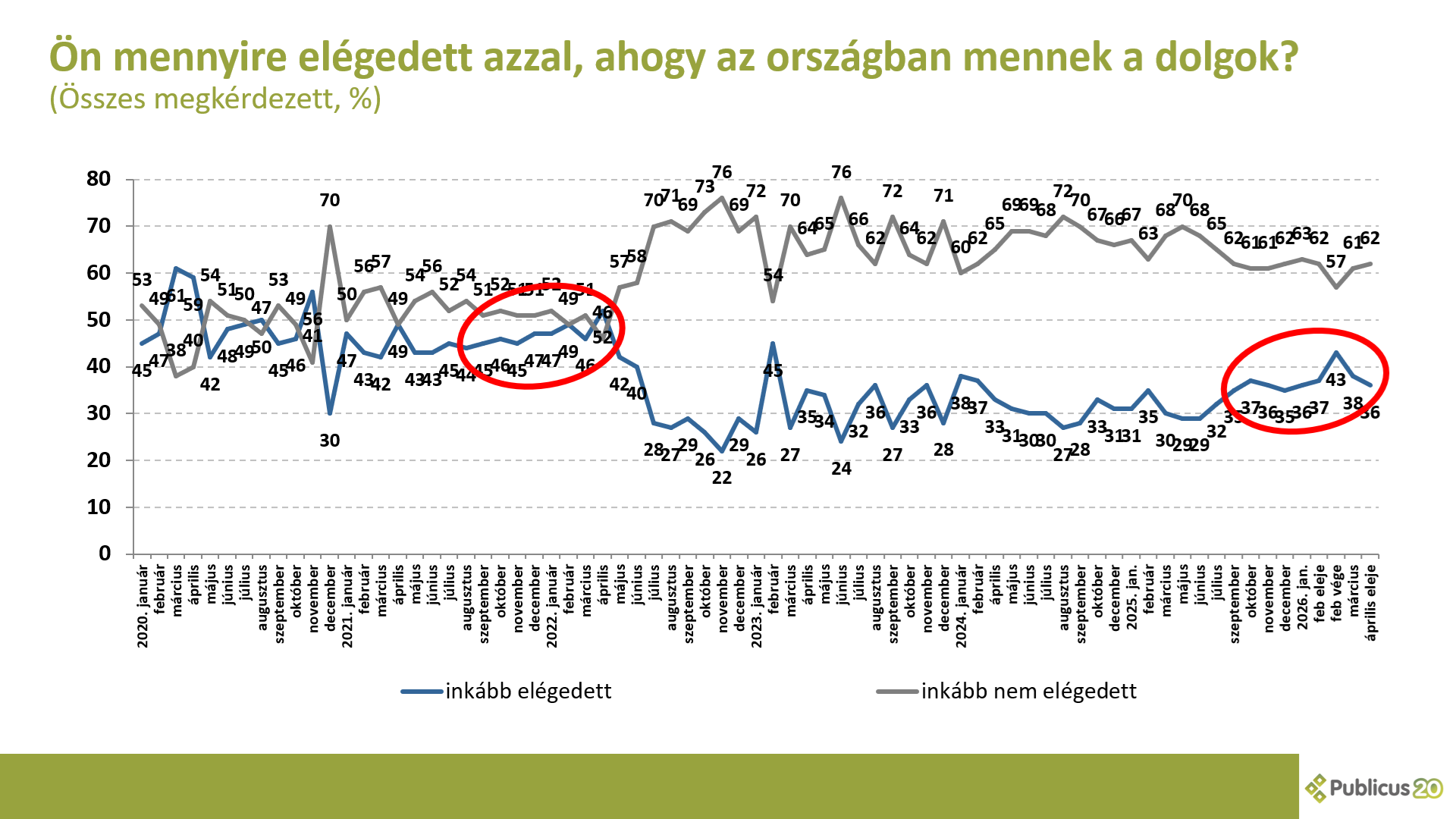
In a peculiar way, one of the main pillars of the government’s strategy has collapsed. While four years ago the massive pre-election spending flipped the public mood, this time that effect failed to materialize. The proportion of dissatisfied voters has risen to 62 percent, while satisfaction stands at only 36 percent. This figure is significantly lower than it was during the last election. While the distribution of money had an impact, the momentum has stalled. People feel they are living worse than they did four years ago. It seems that in the current situation, the everyday experience of the citizens proved stronger than the envelopes.
The Three Holy Grails: Belief, Money, and the Neighbor
As we wrote previously, indirect indicators measure the true social gravity. Let’s see what happened in these final days:
- Belief in an Election Victory: At the end of March, there was only a 1-percentage-point difference. Today, however, 42 percent believe in a change of government, compared to 36 percent who expect Fidesz to stay. The “myth of invincibility” has finally evaporated.
- The 10,000 HUF Test: When it comes to their own money, 43 percent of voters would bet on Tisza, and only 33 percent on Fidesz. This 10-point gap is the triumph of a hard-earned sense of reality over political noise.
- Social Projection (The Neighbor Indicator): This is the most brutal data point. 43 percent see Tisza as the winner in their immediate environment, while only 27 percent feel the same about Fidesz. This 16-point chasm indicates that the bandwagon effect mechanism is running at full steam
With all this, the oppressive burden placed on voters open to the opposition by previous election failures has been lifted; they now believe that Fidesz can finally be defeated. This has pushed many toward the change of government.
What Does This Mean for Mandates?
Among certain voters, the Tisza Party stands at 52 percent, while Fidesz is at 39 percent. This 13-point difference is now beyond the margin of error and a simple list-based victory. However, despite the +/- 3.1 percent margin of error in national list research, it remains very difficult to translate this into mandates. In 10 to 20 electoral districts, the difference between the two strong parties is expected to be within 1,000 votes, and it is hard to say which one will eventually win. Thus, the “margin of error” for mandates remains much larger.
Meanwhile, voters of the small parties—continuing the trend of recent months—have almost entirely “migrated” to Tisza. While six months ago roughly 20 percent of those wanting a change of government would not have voted for Tisza, today this proportion has shrunk to approximately 5 percent. The 2-2 percent support for the DK and the MKKP means they have fallen out of the math, while Mi Hazánk is balancing on the edge of a needle at 5 percent.
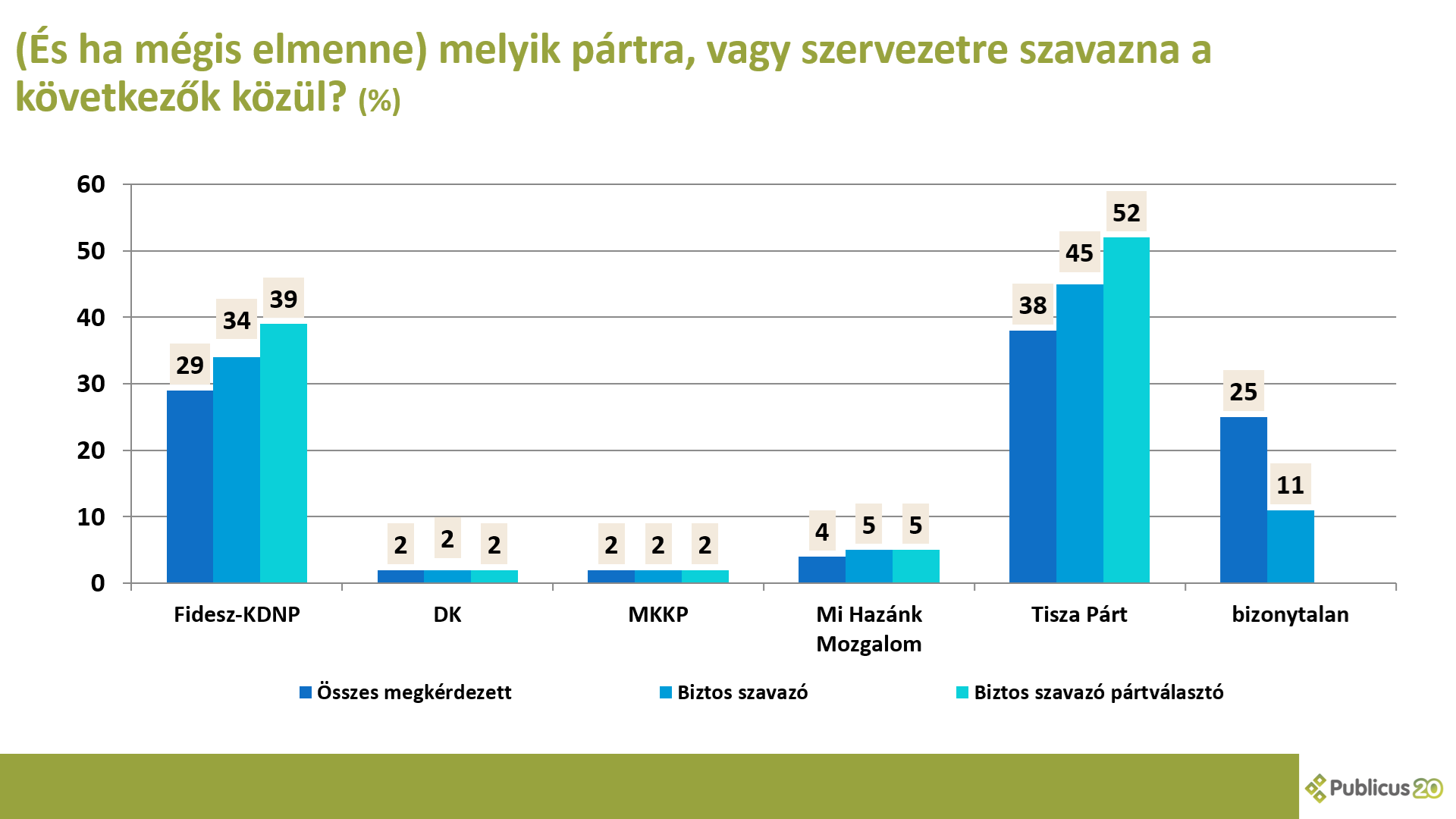
For the first time in a long while, support for Mi Hazánk (Our Homeland) is showing signs of decline; in previous months, we measured them steadily at 6–7 percent. This erosion is not independent of the campaign launched by Fidesz and influencers surrounding MH, aimed at splitting the vote among the party’s supporters. This is quite destructive to the party’s identity, especially since in certain groups—primarily those west of the Danube—Fidesz is not the secondary preference for their voters.
In the recent period, the party was well-served by keeping its cooperation or potential coalition with Fidesz secret and “floating” in strategic ambiguity. However, this kind of rapprochement with the ruling party is chipping away at the 35–40 percent of Mi Hazánk’s base that leans toward Tisza and a change of government.
Record Turnout and Tectonic Shift
86 percent of voters already know for sure who they will vote for. Political excitement is immense: although the participation promise is 76 percent, as an analyst, I say reality will be between 70 and 75 percent, representing a record or near-record turnout.
However, while 95 percent of Tisza supporters claimed they would definitely go to vote, only 90 percent of Fidesz supporters said the same. Thus, Fidesz’s mobilization lags 5 percentage points behind Tisza’s. This may indicate a sort of “freezing” or uncertainty within the pro-government camp in the final days—especially since this indicator showed only a 3-point lag last month, whereas previously it was over 10.
Unless an unexpected “Black Swan” arrives in the final 48 hours, we can prepare for a stable, convincingly majority Tisza victory on Sunday. The psychological dam has broken, and political gravity is now doing its work relentlessly.